Improvement
Why Most Founders Hire Too Early
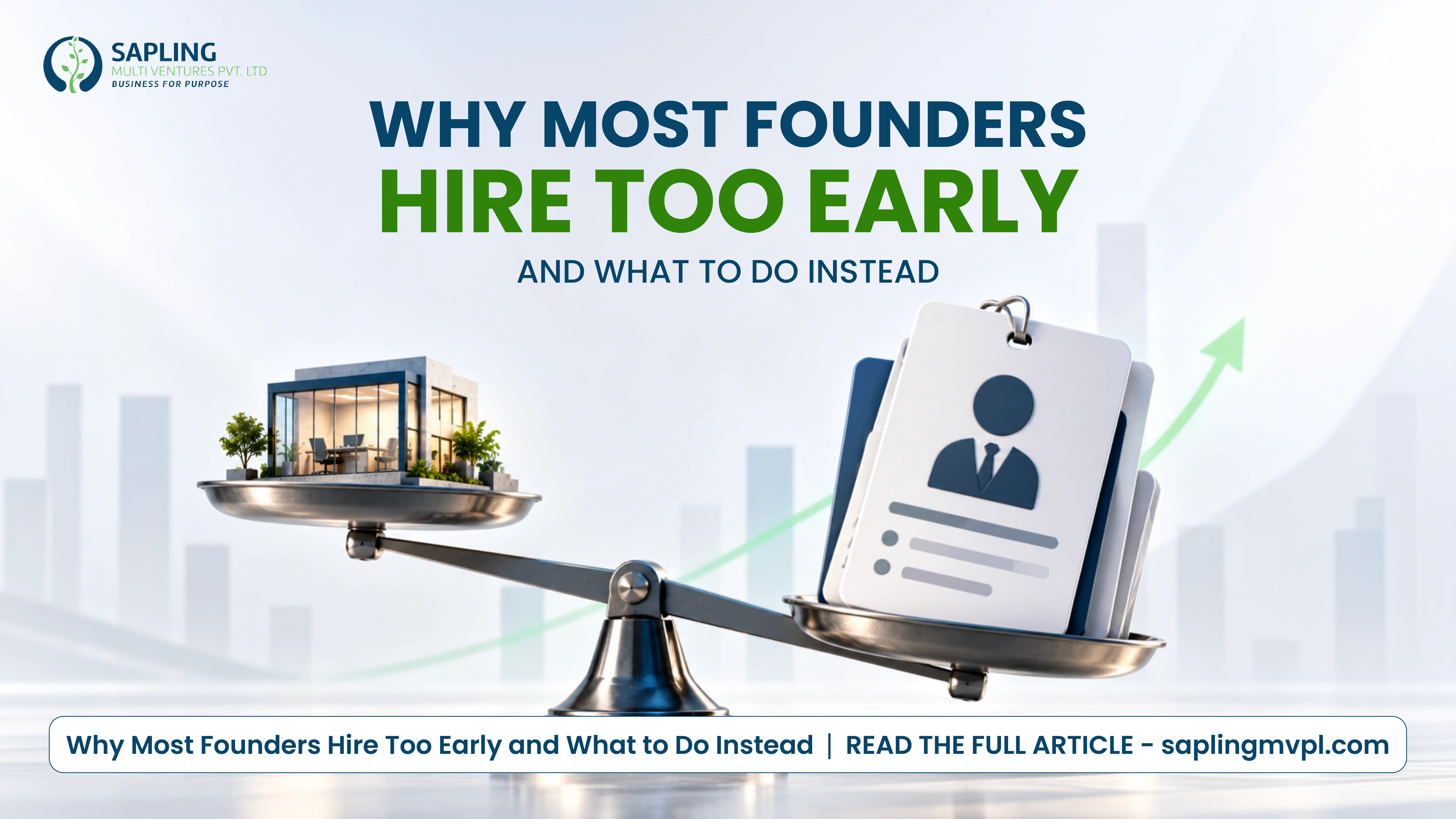
Why Most Founders Hire Too Early and What to Do Instead
A funding round closes. Within weeks, the team doubles.
It feels like progress. Headcount looks like momentum, and momentum is what founders are supposed to show investors, customers, and themselves.
It is also one of the most reliable ways to kill an early-stage business.
Research from Startup Genome found that 74% of high-growth startups in their study failed specifically because of premature scaling, and startups that scaled at the right time grew roughly 20 times faster than the ones that scaled too early. The single biggest lever founders pull too early, too fast, is often people.
This is not an argument against hiring. It is an argument against hiring on the wrong signal.
What the Data Actually Shows
Premature scaling is not a vague warning. Startup Genome's research found that startups in their sample that scaled their team prematurely ended up with a headcount roughly three times larger than consistently-performing startups at the same stage. Properly-scaled startups kept growing steadily after that point and critically, they were the ones still standing to do it.
In that same research, no startup that scaled prematurely passed the 100,000-user mark.
The pattern is not "hiring is bad." It is that hiring ahead of a validated need consumes cash and adds coordination overhead faster than it adds output, and the two compound against each other at exactly the moment a young company can least afford it.
Why Founders Hire Early Anyway
Two forces push founders toward hiring before they need to.
The first is psychological. Closing a funding round creates a sense of permission, money in the bank feels like a mandate to spend it on growing the team, even when the product has not yet earned that growth.
The second is signaling. A bigger team looks like a more serious company to investors, to customers, and often to the founder's own sense of progress. Headcount becomes a stand-in for traction, even when the two have not actually connected yet.
Both instincts are understandable. Both are wrong. Neither funding nor appearances are evidence that the business is ready to support the people being hired.
What Premature Scaling on the Team Actually Looks Like
It rarely looks like one bad decision. It looks like a pattern of individually reasonable-seeming ones:
• Hiring specialists - a dedicated customer service team, a database administrator, a CFO, before their function is actually the bottleneck.
• Adding a layer of management, hiring VPs or product managers to oversee people, instead of hiring more people who directly build or sell.
• Titles assigned before the role itself is clearly defined, often to make a job posting more attractive than the stage of the company justifies.
• Hiring to "look ready" for a specific investor conversation or customer pitch, rather than because the workload demands it.
Each of these feels like professionalising the company. In combination, before product-market fit is established, they are usually the fastest way to burn through a raise without anything to show for it.
The Milestone-Driven Hiring Framework
The alternative to hiring on funding or optics is hiring on a specific, testable output.
Define the output before the role
Before opening a role, name exactly what hiring for it unlocks. Not "we need someone in marketing," but the specific outcome that person's work should produce, and by when.
Set a 90-day evaluation point
Every hire should have a defined checkpoint, typically around 90 days, where the founder can honestly assess whether the specific output was delivered. If the answer is unclear, the role was defined too vaguely to have been hired for in the first place.
Hire builders before managers
At the earliest stages, the distinction that matters most is builder versus manager. A builder creates process from scratch, in ambiguity, with no playbook. A manager operates within an existing process. Most early hires, including the first few beyond the founding team - need to be builders. The need for managers comes later, and hiring one too soon adds a coordination layer with nothing yet to coordinate.
Scaling Trust Instead of Headcount
The deeper problem premature hiring is often trying to solve is a founder bottleneck: too many decisions still routing through one person.
Shopify's Tobi Lütke has described a useful mental model for this: a "trust battery" that starts around 50% for any new working relationship and either charges or drains with every interaction, a delivered commitment charges it, a missed deadline or an unclear mistake drains it. The idea is that when trust is high across a small team, fewer decisions may need the founder's direct sign-off; when it is low, more decisions tend to require verification regardless of headcount.
The practical implication: before hiring to remove a bottleneck, it is worth asking whether the bottleneck is actually a headcount problem, or a trust and clarity problem that more people would not solve and might make worse.
What to Do Instead of Hiring
Before opening a new role, three questions are worth answering honestly.
Can this work be done by an existing team member for the next quarter, even imperfectly? Is there a contractor, freelancer, or agency relationship that tests the need without a permanent commitment? And most importantly, is there clear, repeated evidence of demand for this function, or is this a bet that demand will show up once the role exists?
A role opened to test a hypothesis about the business is a very different decision from a role opened because the evidence already demands it. Only the second is scaling. The first is premature scaling wearing scaling's clothes.
Frequently Asked Questions
What percentage of startups fail due to premature scaling? Research from Startup Genome found that 74% of high-growth startup failures in their study involved premature scaling, including hiring ahead of validated demand.
Why do founders hire too early? Two main reasons: funding creates a psychological sense of permission to spend on headcount, and a larger team signals progress to investors and customers even without matching traction.
What is the milestone-driven hiring framework? A framework where each new hire is tied to a specific, articulated output, evaluated at a defined checkpoint, typically around 90 days rather than hired on funding availability or general growth optimism.
Should a startup hire specialists or generalists first? Generalists and builders first. Specialists, dedicated customer service teams, database administrators, and similar roles are usually premature until their specific function is the actual bottleneck.
What is the difference between a builder and a manager in early hiring? A builder creates process from scratch with no existing playbook. A manager operates within a process that already exists. Early-stage hires typically need to be builders.
Is hiring itself the problem, or the timing? Hiring isn't the problem, hiring without a specific, testable reason for that role at that moment is. Timing is what turns an ordinary hiring decision into premature scaling.
What should a founder do instead of hiring for a new function? Test whether an existing team member, a contractor, or an agency relationship can validate the need first, before committing to a permanent hire.
Statistics cited above come from third-party research (linked) and reflect the studies' own samples and methodology, not a guarantee about any individual business. This article is general information, not financial or legal advice.
At Sapling, guidance on hiring and operational sequencing is part of how we support founders through the early stages, not just when to raise capital, but when to spend it on people.
Learn how Sapling supports founders: saplingmvpl.com/what-we-provide
Get in touch: saplingmvpl.com/contact
Sapling Multi Ventures Pvt Ltd | Business for Purpose.
Related