Design
Why "Build It and They Will Come" Kills Most First Businesses
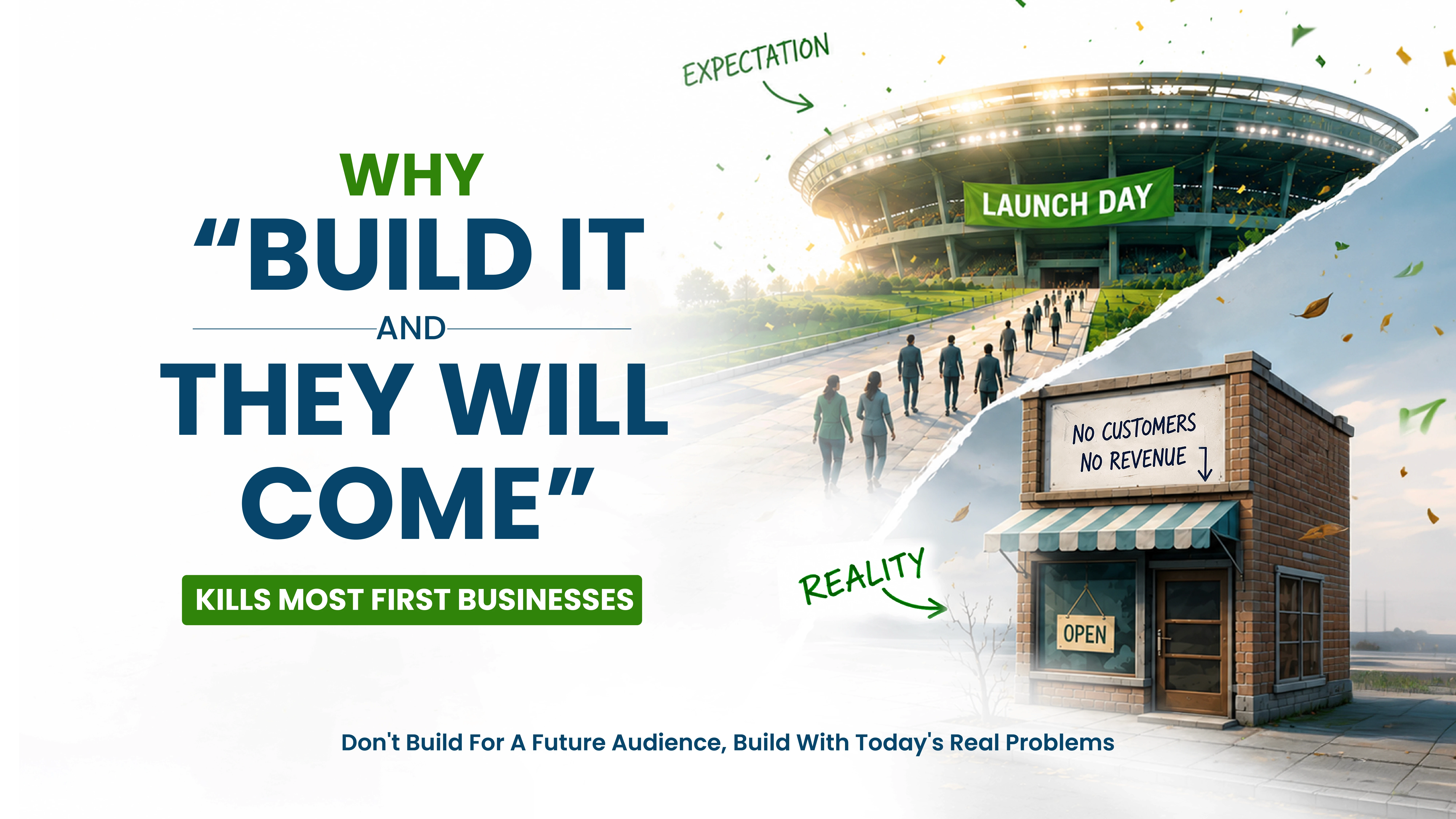
Why "Build It and They Will Come" Kills Most First Businesses
Most first businesses do not fail because they were built badly.
They fail because they were built before anyone proved they were needed.
The product is good. The idea makes sense. The execution is solid. Once it launches, people will discover it, use it, pay for it, and tell others about it.
It is one of the most common beliefs in entrepreneurship.
It is also one of the most expensive.
Most startups fail not because they lack talent, funding, or effort, but because they never confirm that real demand exists. Instead of testing whether the market is ready, many founders build first and hope customers arrive later. This mindset remains one of the most common causes of startup failure.
Lack of market demand is consistently cited as the number one reason startups fail. Not competition. Not funding. Not timing. The product existed. The demand did not.
This is the "build it and they will come" trap. Understanding why it kills so many first businesses is the first step toward building one that survives.
The Real Reason Why Startups Fail
Ask most founders what went wrong and they will point to funding, competition, poor timing, or economic conditions.
Rarely do they say: we built something nobody needed.
Yet that is often the underlying issue.
The biggest startup risk is not running out of money. It is spending money solving a problem that customers do not care enough about to pay for.
The logic behind building first feels reasonable. You have an idea. You believe in it. You want to see it exist. So you build. And then you wait.
The problem is that belief is not validation. Passion is not proof. Time, money, and energy spent building without confirming demand is not an investment. It is a bet placed before the odds are known.
Belief is not validation. Passion is not proof.
Many founders fall into a related trap called premature scaling. They hire quickly, expand early, and add features before understanding what customers actually value. A few enthusiastic early users create false confidence. Early traction does not always mean widespread demand exists. Without confirming this, growth can amplify problems rather than solve them.
What Product-Market Fit Actually Means
Few concepts are discussed more in startup culture. Few are also misunderstood more often.
Product-market fit does not mean your early users like the product. It does not mean revenue is coming in. It does not even mean people are signing up.
Product-market fit exists when a specific group of customers has a specific problem and your solution solves it significantly better than any available alternative. They do not just use the product. They depend on it. They recommend it. They would genuinely miss it if it disappeared.
Marc Andreessen, who popularised the term, described it as something you can feel. When you do not have it, sales cycles feel difficult, customers disappear quickly, referrals are weak, and growth requires constant effort. When you do have it, demand pulls the product forward, customers return naturally, and word-of-mouth does the work.
Most founders focus on scaling before achieving this. That is the wrong sequence. Product-market fit should come before growth, not after it.
Why Market Validation Has to Come Before Execution
Market validation is not a step that happens after you build. It is the step that happens before.
It is the process of confirming, with real evidence rather than assumptions, that a genuine problem exists, that customers actively seek solutions, that they are willing to pay for one, and that your approach is meaningfully better than what they currently use.
Done well, market validation changes everything about how you build. It tells you who your actual customer is, not who you assumed. It tells you how they describe their problem, which shapes how you talk about your solution. It tells you what they have already tried and why it did not work, which tells you where your product needs to be different.
None of this requires a finished product. That is the point.
The goal is not to prove you are right. It is to find out as quickly and cheaply as possible whether you are wrong, before the cost of being wrong becomes unrecoverable.
The Minimum Viable Product: What It Is and Why Most Founders Get It Wrong
The concept of a minimum viable product is one of the most important ideas in modern entrepreneurship. It is also one of the most misunderstood.
A minimum viable product is not a cheaper version of your final product.
It is the smallest possible experiment that lets you test whether your most important assumption about the business is correct.
Its purpose is not launching. Its purpose is learning.
The best MVPs often do not look like products at all. They can be a landing page, a waitlist, a pre-sale offer, a manual process, or simply a structured conversation with potential customers. The goal is to test your biggest assumption before investing heavily in building.
This approach comes from Lean Startup methodology, which asks one question above all others: should we build this? Not can we build it. Not how quickly can we build it. Whether the world actually needs it built at all.
That single question can save months of wasted effort and significant capital.
How to Validate a Business Idea Before Spending a Single Rupee
Validation is not complicated. What makes it difficult is emotional attachment to the idea and a genuine unwillingness to hear no. The framework itself is straightforward.
Start with the problem, not the solution
Talk to potential customers about their lives. Do not pitch your idea. Ask what frustrates them, how often the problem occurs, what they have already tried, and what it costs them. If the problem does not come up naturally, it may not be urgent enough to build a business around.
Test demand before building anything
A simple landing page describing your solution and offering a waitlist reveals more about real demand than months of planning. If people will not sign up for something that does not exist yet, convincing them after you build it will be harder, not easier.
Sell before you build
This is the single most underused validation method. Go to potential customers, explain what you are planning to build, and ask for payment. Not feedback. Not encouragement. Real payment. If nobody will pay for an idea they claim to believe in, the market is telling you something important.
Look for existing demand signals
Great businesses often emerge where demand already exists. Look at search trends, online communities, forums, and industry groups. If people are already searching for a solution, you are serving existing demand rather than trying to create it from scratch. That is always the easier path.
Real Founders Who Validated Before They Built
This is not just theory. Some of the world's most successful companies started with simple experiments designed to test demand before committing to development.
Dropbox
When Dropbox was still an idea, building the technology would have taken significant time and resources. Instead of building first, founder Drew Houston created a short video demonstrating how the product would work. Thousands of people joined the waiting list before a single line of real product code was written. That demand signal validated the opportunity and justified the investment that followed.
Airbnb
Airbnb did not begin as a global accommodation platform. The founders rented air mattresses in their own apartment to visitors attending a local conference. No technology. No marketing. Just a simple test of whether people would pay for an alternative to hotels. The answer was yes, and that small validation gave them the confidence to keep building.
Zappos
Zappos founder Nick Swinmurn wanted to test whether people would buy shoes online. Rather than investing in inventory, he photographed shoes in local stores and listed them online. When someone ordered, he bought the shoes from the store and shipped them himself. The process was manual and inefficient. But it proved that demand existed. Only after that confirmation did the company invest in scaling.
The pattern across all three is the same: validate first, build second.
What Changes When You Get This Right
When market validation comes before execution, everything about how you build changes.
You build less because you know exactly what customers need rather than what you assumed. You spend less because development decisions are based on evidence rather than belief. You move faster because you are not rebuilding features nobody asked for. And you reach a product that the market actually wants significantly sooner, because you started from confirmed demand rather than a hopeful assumption.
The businesses that get this right are not the ones with the biggest budgets or the most experienced teams. They are the ones who stayed curious about whether they were right long enough to find out before it cost everything to be wrong.
The Broader Pattern
"Build it, and they will come" sounds like confidence. But it is not a strategy. It is hope.
Hope is important. Every founder needs optimism to keep going. But optimism without evidence is dangerous, especially in the early stages when every decision shapes whether the business survives.
The founders who get through the first two years are not always the smartest or the best funded. They are the ones who remained curious about whether they were right. They sought evidence before commitment. They learned before they scaled.
The founders who survive are not the ones who built the most. They are the ones who found out what to build first.
That skill can be learned. And it often becomes the difference between a business that struggles to find its market and one that grows because the market was already waiting for it.
Frequently Asked Questions
Why do startups fail?
The most common reason startups fail is a lack of market demand. Many founders build products without first confirming whether customers genuinely need the solution they are creating.
What is product-market fit?
Product-market fit occurs when a product successfully solves an important problem for a specific group of customers who consistently use it, value it, and recommend it to others.
What is a minimum viable product?
A minimum viable product (MVP) is the simplest experiment that allows founders to test their core business assumptions and gather customer feedback before investing heavily in full development.
How do you validate a startup idea?
Through customer conversations, pre-sales, waitlists, landing pages, and MVP experiments designed to measure genuine customer interest and willingness to pay before building.
How do you test market demand?
Through pre-orders, sign-up pages, direct sales conversations, customer interviews, and search trend analysis that reveal whether real demand exists for the solution you are considering.
What is startup validation?
Startup validation is the process of gathering evidence that a business idea solves a real problem and has enough genuine customer demand to justify further investment of time and capital.
What does PMF mean in startups?
PMF stands for product-market fit. It refers to the point at which a product satisfies a strong market need and gains consistent, organic customer adoption.
How do you validate an idea for a startup?
Start by understanding the problem deeply, speak with potential customers before building anything, test interest through low-cost experiments, and measure willingness to pay before committing to a full solution.
At Sapling, helping founders validate before they build is a core part of how we approach early-stage support.
The goal is not to slow down execution. It is to make sure time, capital, and effort are invested in ideas with real market demand and a clear path toward sustainable growth.
Learn how Sapling supports founders: saplingmvpl.com/what-we-provide
Get in touch: saplingmvpl.com/contact
Sapling Multi Ventures Pvt Ltd | Business for Purpose.
Related