Start-Up Guide
Startup Infrastructure: What Founders Actually Need in Year One | Sapling
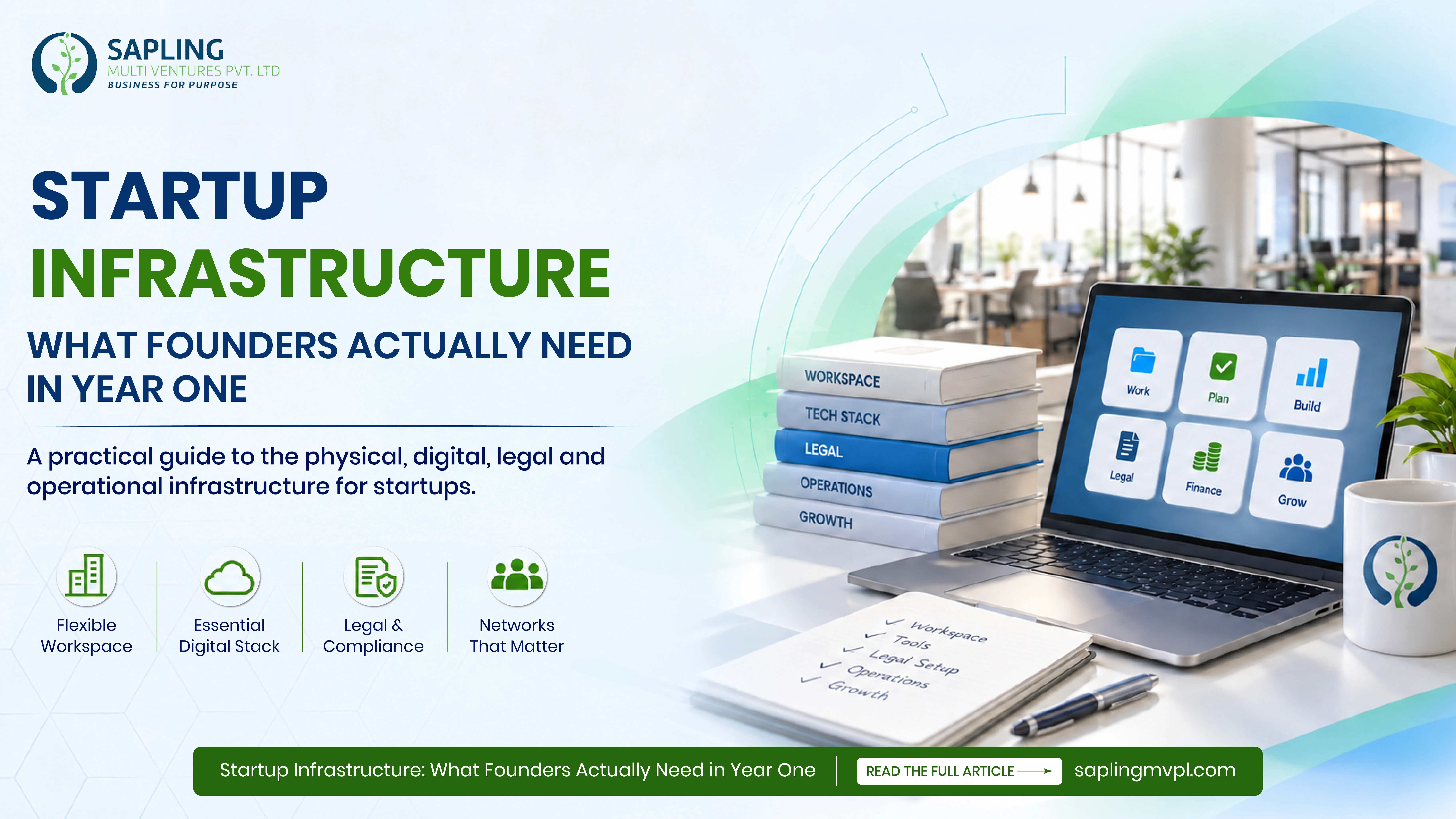
Startup Infrastructure 101: What Founders Actually Need in Year One
Most founders think about infrastructure the wrong way.
They imagine a proper office, a full tech stack, a legal retainer, and a clean set of internal systems, the trappings of a real company.
Then they either overspend on all of it in month one, or delay building any of it and pay for that delay in wasted hours, legal exposure, or a team quietly working out of five different tools that do not talk to each other.
Infrastructure is not about looking established. It is about removing friction from the things you have to do every week so more of your time goes into the things that actually decide whether the business survives.
Here is what founders genuinely need in year one, what can wait, and what most people get backwards.
Physical Space: Rent Flexibility, Not an Address
A fixed lease is one of the most common early mistakes. It locks in a cost before the team size or work style is proven, and it is one of the hardest commitments to unwind if the business pivots.
Coworking has made this largely unnecessary. Pricing in India reportedly ranges from roughly ₹75 a day for a hot desk to premium branded floors running into the tens of thousands per month, exact rates vary by city and operator, which means a solo founder testing an idea and a funded ten-person team have very different starting points, and neither necessarily needs a traditional lease to get there.
The distinction worth understanding early is coworking versus incubation. A coworking space sells flexible desks with no equity involved and no obligation beyond the subscription. An incubator offers a more complete package - mentorship, investor access, sometimes seed capital but usually asks for equity or a structured programme commitment in return. Founders who need space and nothing else should not sign up for an incubator's terms just to get a desk.
A useful rule: rent the smallest footprint that fits the team for the next two quarters, not the next two years.
Digital Infrastructure: The Stack That Actually Matters
Digital infrastructure gets treated as a shopping list, accounting software, a CRM, a project tool, a communication app - when the real question is narrower: which systems does the business depend on so heavily that losing them for a day would stop work?
In year one, that is usually a short list: a place all financial records live (not spreadsheets scattered across laptops), a single source of truth for customer or client information, and one communication channel the whole team actually uses. Everything else, elaborate dashboards, automation stacks, multiple project management tools tried in parallel, is optimisation for a team that does not exist yet.
The mistake to avoid is not under-investing. It is over-tooling: paying for and maintaining systems built for a 20-person company when the team is three people who still talk to each other daily.
Production and Delivery Infrastructure
For founders building anything that requires content, media, or a physical product, not just software - production infrastructure is the piece most commonly missed entirely.
This covers the pipelines that turn an idea into something deliverable: a place to shoot and edit if the business runs on video or content, a reliable manufacturing or fulfilment partner if it ships a physical product, or a documented, repeatable process if the output is a service. Founders who skip this step end up rebuilding the same workflow from scratch every single time instead of running it.
The test is simple: could someone other than the founder run this process today, following written steps, without the founder explaining it from memory? If not, the infrastructure is not the software or the studio, it is the missing documentation.
Legal and Compliance Infrastructure
This is the infrastructure category founders most often postpone, and the one that is most expensive to postpone.
At minimum, year one generally needs: the right entity structure filed correctly from day one (changing it later is typically far more expensive than getting it right first), a basic contract template for clients or customers, a founder agreement if there is more than one founder, and DPIIT recognition if the business qualifies, since recognition can unlock self-certification under nine labour laws and three environmental laws, which may remove a meaningful amount of early compliance overhead. Confirm current requirements with a legal or company-secretarial professional before acting on any of this.
A founder agreement in particular is infrastructure that is nearly impossible to retrofit once a disagreement has already started. It costs almost nothing to put in place early and can cost the entire business to skip.
Network Infrastructure: Who You Can Actually Call
The fourth kind of infrastructure is the least tangible and the most overlooked: a working set of relationships a founder can call on without cold-starting every time, a mentor who has solved a similar problem, a peer group of other founders at a similar stage, and access to the specific industry contacts the business actually needs, rather than a generically large network.
This is usually where incubators and structured founder ecosystems earn their equity ask: not the desk, but the shortcut to relationships that would otherwise take years to build organically.
What to Build First, and What Can Wait
In order, year-one priority looks like this: legal and entity structure first, because it is the hardest to fix retroactively; a minimal, dependable digital stack second; flexible physical space third, sized to the next two quarters, not the eventual team; and production or delivery infrastructure fourth, built as soon as the process repeats more than a handful of times.
Network infrastructure is not something to build in sequence, it compounds from day one, in parallel with everything else.
What can wait: a permanent office lease, a full enterprise software stack, an elaborate brand system, and any infrastructure investment made because a competitor has it rather than because the business needs it this quarter.
Frequently Asked Questions
Should a new startup rent a permanent office? Usually not in year one. Coworking space offers the same functional workspace with far more flexibility while team size and work style are still being figured out.
What's the difference between a coworking space and an incubator? A coworking space sells flexible desk space with no equity involved. An incubator provides mentorship, investor access, and sometimes capital, usually in exchange for equity or a structured programme commitment.
What digital tools does a startup actually need in year one? A reliable system for financial records, one source of truth for customer information, and a single communication channel the team consistently uses. Additional tools should be added only as a specific, recurring need appears.
Is DPIIT recognition considered infrastructure? Indirectly, yes. It unlocks self-certification under labour and environmental laws, which removes a meaningful amount of routine compliance overhead for an early-stage team.
How much does coworking space cost in India in 2026? Pricing reportedly ranges widely, from roughly ₹75 a day for a hot desk at the lower end to premium branded floors costing several tens of thousands of rupees per month, treat these as indicative, since rates vary by city and operator.
What legal infrastructure should a founder set up first? Correct entity structure, a founder agreement if there is more than one founder, and a basic client or customer contract template.
Do solo founders need the same infrastructure as funded teams? No. A solo founder testing an idea needs a minimal, low-cost setup. Infrastructure should scale with proven need, not be built for a future team size in advance.
Pricing and legal figures cited above are indicative and change over time. This article is general information, not legal, tax, or financial advice, confirm current rates and requirements before budgeting or filing.
Infrastructure is one of the four pillars Sapling builds around, workspaces, production pipelines, and digital systems that remove friction so founders can spend their time on the business itself, not on rebuilding the same process every quarter.
Learn how Sapling supports founders: saplingmvpl.com/what-we-provide
Get in touch: saplingmvpl.com/contact
Sapling Multi Ventures Pvt Ltd | Business for Purpose.
Related